





View count: 3882

Master/Ph.D. Programs, Sustainability in Decarbonization
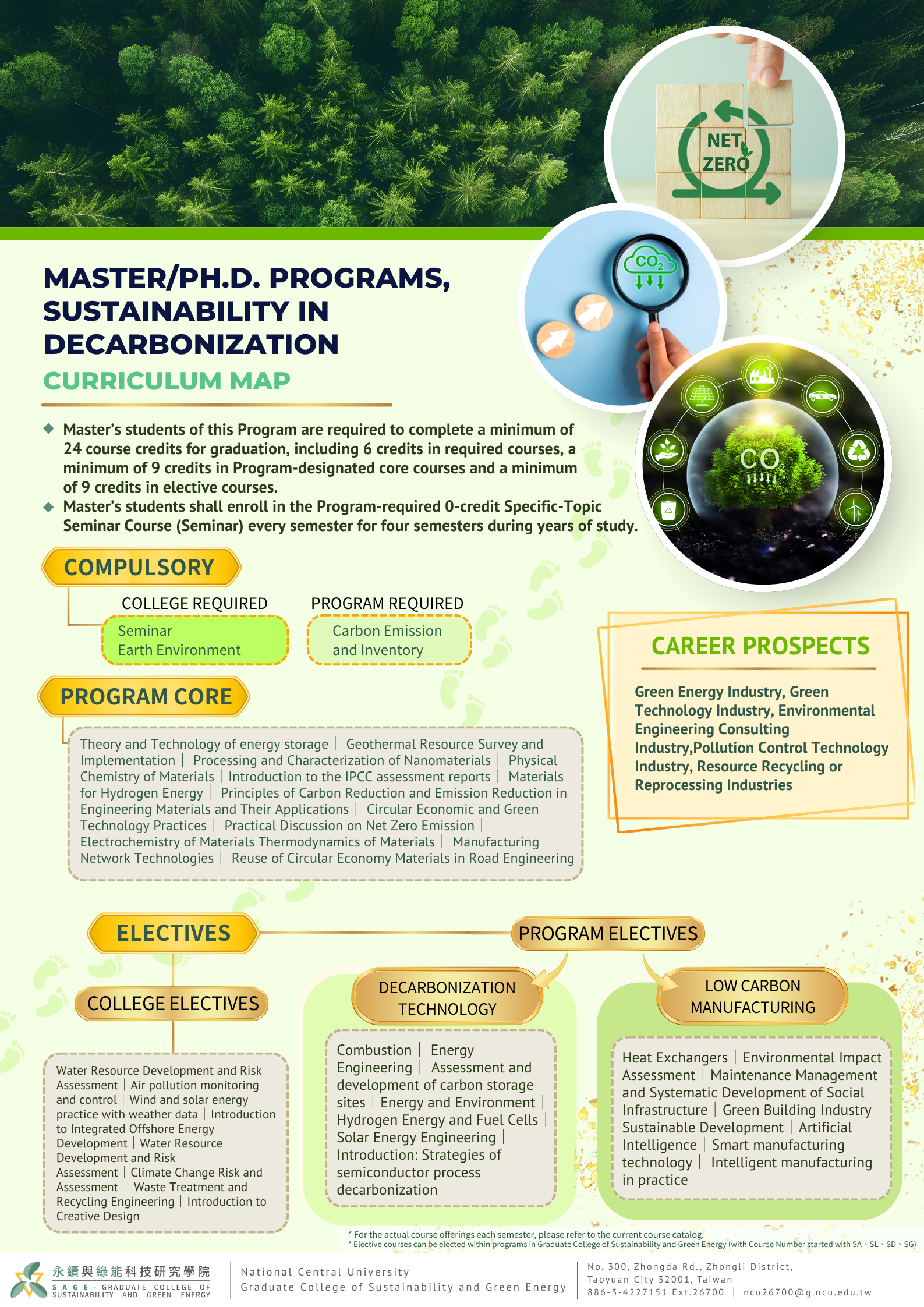
MASTER/PH.D. PROGRAMS, SUSTAINABILITY IN DECARBONIZATION CURRICULUM MAP:1. Master's students of this Program are required to complete a minimum of 24 course credits for graduation, including 6 credits in required courses, a minimum of 9 credits in Program-designated core courses and a minimum of 9 credits in elective courses. 2. Master's students shall enroll in the Program-required 0-credit Specific-Topic
Seminar Course (Seminar) every semester for four semesters during years of study.
PROGRAM CORE:
Theory and Technology of energy storage Geothermal Resource Survey and Implementation | Processing and Characterization of Nanomaterials Physical Chemistry of Materials | Introduction to the IPCC assessment reports Materials for Hydrogen Energy | Principles of Carbon Reduction and Emission Reduction in Engineering Materials and Their Applications | Circular Economic and Green Technology Practices | Practical Discussion on Net Zero Emission | Electrochemistry of Materials Thermodynamics of Materials | Manufacturing Network Technologies | Reuse of Circular Economy Materials in Road Engineering
PROGRAM ELECTIVES provides COLLEGE ELECTIVES and PROGRAM ELECTIVES.
COLLEGE ELECTIVES:Water Resource Development and Risk Assessment Air pollution monitoring and control | Wind and solar enerav practice with weather data | Introduction to Integrated Offshore Energy Development | Water Resource Development and Risk Assessment | Climate Change Risk and Assessment | Waste Treatment and necycling engineering | Introduction to Creative Design
PROGRAM ELECTIVES provides DECARBONIZATION TECHNOLOGY and LOW CARBON MANUFACTURING.
DECARBONIZATION TECHNOLOGY:Combustion | Energy Engineering Assessment and development of carbon storage sites | Energy and Environment |  Hydrogen Energy and Fuel Cells | Solar Energy Engineering Introduction: Strategies of semiconductor process decarbonization
LOW CARBON MANUFACTURING:Heat Exchangers | Environmental Impact Assessment | Maintenance Management and Systematic Development of Social Infrastructure | Green Building Industry Sustainable Development | Artificial Intelligence | Smart manufacturing technology | Intelligent manufacturing in practice
CAREER PROSPECTS:Green Energy Industry, Green Technology Industry, Environmental Engineering Consulting Industry, Pollution Control Technology Industry, Resource Recycling or Reprocessing Industries

CURRICULUM MAP

  • Master's students of this Program are required to complete a minimum of 24 course credits for graduation, including 6 credits in required courses, a minimum of 9 credits in Program-designated core courses and a minimum of 9 credits in elective courses.
  • Master's students shall enroll in the Program-required 0-credit Specific-Topic Seminar Course (Seminar) every semester for four semesters during years of study.

COMPULSORY

COLLEGE REQUIRED:Seminar, Earth Environment

PROGRAM REQUIRED:Carbon Emission and Inventory

PROGRAM CORE:

Theory and Technology of energy storage Geothermal Resource Survey and Implementation | Processing and Characterization of Nanomaterials Physical Chemistry of Materials | Introduction to the IPCC assessment reports Materials for Hydrogen Energy | Principles of Carbon Reduction and Emission Reduction in Engineering Materials and Their Applications | Circular Economic and Green Technology Practices | Practical Discussion on Net Zero Emission | Electrochemistry of Materials Thermodynamics of Materials | Manufacturing Network Technologies | Reuse of Circular Economy Materials in Road Engineering


ELECTIVES
COLLEGE ELECTIVES
  • Water Resource Development and Risk Assessment
  • Air pollution monitoring and control
  • Wind and solar enerav practice with weather data
  • Introduction to Integrated Offshore Energy Development
  • Climate Change Risk and Assessment
  • Waste Treatment and necycling engineering
  • Introduction to Creative Design

PROGRAM ELECTIVES
DECARBONIZATION TECHNOLOGY
  • Combustion
  • Energy Engineering
  • Assessment and development of carbon storage sites
  • Energy and Environment
  • Hydrogen Energy and Fuel Cells
  • Solar Energy Engineering
  • Introduction: Strategies of semiconductor process decarbonization
LOW CARBON MANUFACTURING
  • Heat Exchangers
  • Environmental Impact Assessment
  • Maintenance Management and Systematic Development of Social Infrastructure
  • Green Building Industry Sustainable Development
  • Artificial Intelligence
  • Smart manufacturing technology
  • Intelligent manufacturing in practice


CAREER PROSPECTS

Green Energy Industry, Green Technology Industry, Environmental Engineering Consulting Industry, Pollution Control Technology Industry, Resource Recycling or Reprocessing Industries

The course list shall be subject to the most current version of the academic regulations.